
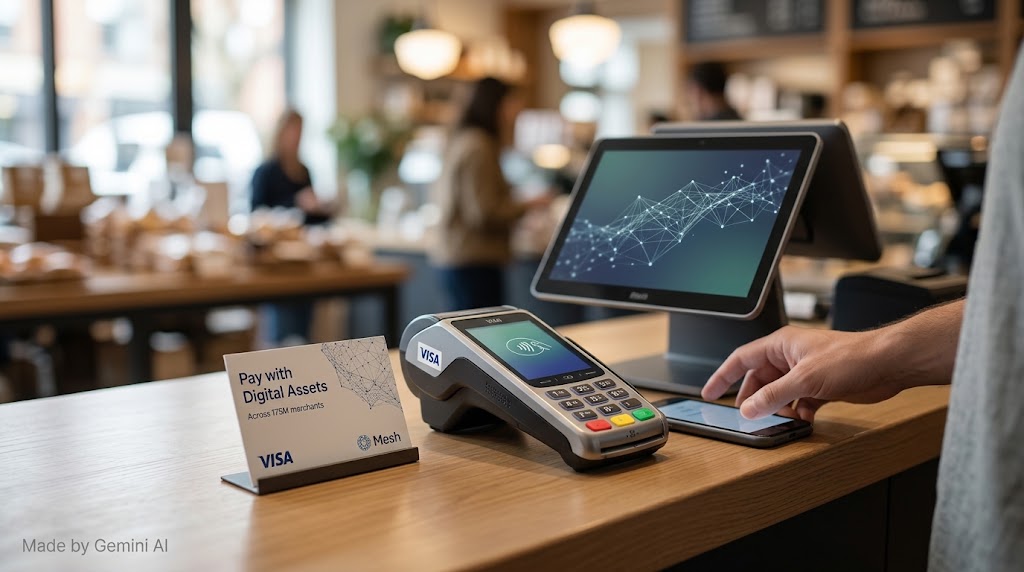
Visa and Mesh have introduced a strategic partnership designed to make crypto and stablecoin balances spendable throughout Visa’s world acceptance community of 175 million service provider areas in additional than 200 nations. The deal targets what Mesh describes because the last-mile drawback in digital-asset funds: the friction between proudly owning crypto and truly spending it.
The mechanics are easy in precept. Mesh provisions a Visa credential behind the scenes when a shopper needs to pay. The person faucets or checks out on-line as regular; the service provider receives a typical card cost with no new {hardware} or workflow adjustments required. Mesh handles the funding, conversion and, the place required, KYC and person onboarding, appearing as programme supervisor. The shopper doesn’t want to pre-sell holdings, switch funds to a checking account, or join a separate card linked to a single platform.
The last-mile drawback in context
The launch cites Crypto.com analysis placing world crypto possession at 774 million folks as of June 2026. Yet American Banker knowledge referenced within the launch places month-to-month crypto card volumes at roughly $1.5 billion by late 2025, a determine that, set in opposition to Visa’s $14.2 trillion in fiscal 2025 cost quantity, illustrates how little of that possession has transformed into on a regular basis spending. The hole shouldn’t be primarily a product of shopper reluctance; it displays the structural friction of present rails. Every present route from a stablecoin stability to a fiat point-of-sale transaction requires a previous motion by the buyer.
Mesh says it already serves greater than 200 enterprise shoppers, together with Kalshi, Tools for Humanity, Félix Pago, Majority and KAST, and its community connects lots of of wallets, exchanges and platforms. That present distribution is the industrial logic of the Visa deal: Visa brings ubiquitous service provider acceptance, and Mesh brings the orchestration layer that aggregates fragmented digital-asset balances.
“Crypto never had a spending problem, it has a last-mile problem, and until now, closing it meant getting a separate card,” stated Bam Azizi, chief government and co-founder of Mesh. “Mesh handles the funding and conversion, so a balance becomes purchasing power at the moment of payment, with nothing for the user to move and nothing for the merchant to change.”
Competitive and regulatory read-across
The partnership sits inside a broader push by card networks to combine digital property into conventional cost flows. Visa has beforehand labored with Circle and different stablecoin issuers on settlement rails, and Mastercard has pursued related orchestration partnerships. The differentiator Mesh is positioning right here is wallet-agnosticism: somewhat than tying the expertise to a single issuer or platform, Mesh aggregates throughout wallets so a shopper can spend from whichever stability they maintain, wherever they occur to be.
On the regulatory facet, stablecoin cost infrastructure is drawing growing legislative consideration in each the US and the EU. In the US, the Genius Act and parallel House payments are progressing via Congress and would set up a federal licensing framework for stablecoin issuers, doubtlessly clarifying the compliance path for programme managers like Mesh. In the EU, MiCA’s asset-referenced token provisions are already reside, and the European Central Bank is watching stablecoin cost volumes with shut curiosity. Neither growth blocks the Visa-Mesh mannequin, however each will form how rapidly collaborating platforms can onboard customers in regulated jurisdictions.
The announcement doesn’t verify a launch date, identify the primary collaborating pockets platforms past present Mesh shoppers, or disclose industrial phrases. Rollout particulars are described as forthcoming. The key near-term markers are the jurisdictions the place the product goes reside first, the stablecoin denominations supported at launch, and whether or not any main shopper pockets outdoors Mesh’s present enterprise roster indicators on.
AI stage 1 of 5: written by Darlyn Ho; AI helped with tone, construction or wording; edited and signed off by Mark Walker, Editorial Director. What the levels mean