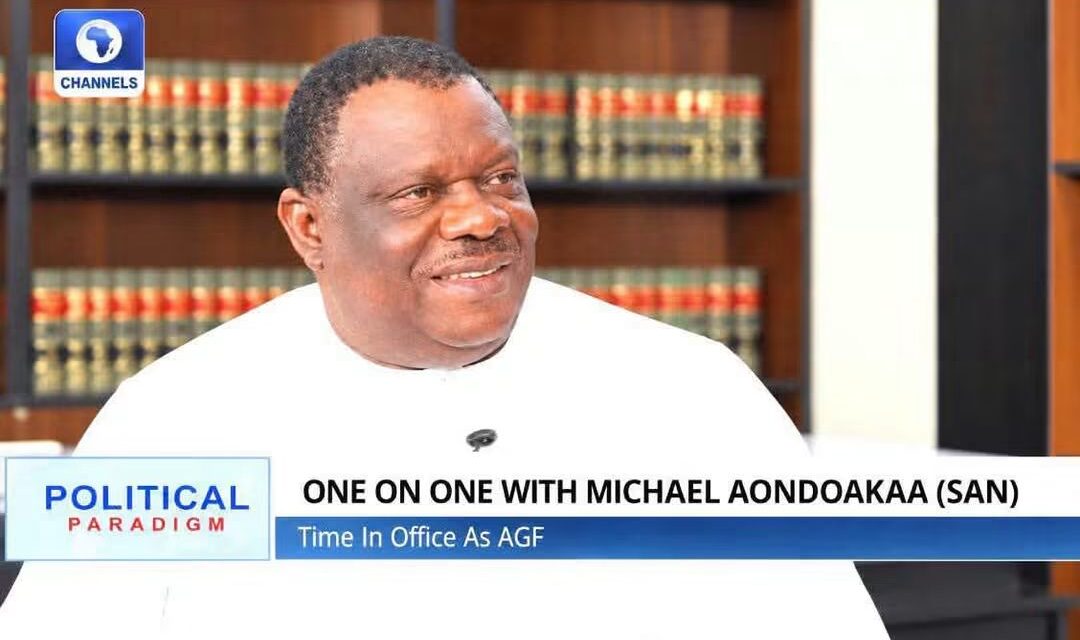
How does a state raise more money without squeezing the people who earn it? That question sat at the centre of a recent television interview with Chief Michael Kaase Aondoakaa, SAN, a former Attorney General of the Federation and Minister of Justice, who shared his views on the economic outlook for Benue State.
Appearing on Channels Television’s Political Paradigm, Aondoakaa spoke about taxation, insecurity and the slowdown in trade across parts of the state. His central argument was that revenue growth follows a thriving local economy, not the other way around.
Also Read: Shettima Questions Atiku, Obi’s Economic Plans for Nigeria
The Case for Lower, Simpler Taxes
Aondoakaa said heavy taxation can backfire. “When you lower taxes, people pay more; when you hike taxes, businesses run away,” he said.
His suggested fix is a single-point payment system. Under his proposal, a trader who has already paid tax on goods at the local government level would not be taxed again by the state when moving those goods out of Benue. He described the idea this way:
“If you buy something in Jato-Aka and the local government issues you a tax receipt after payment, you should be free to transport those goods out of Benue without being subjected to another tax on the same goods by the state government.”
In practical terms, the proposal targets what many traders describe as repeated charges at different points along a trade route. Supporters of such reforms argue that fewer levies make compliance easier and can widen the tax base, while critics often point out that states must also protect their income sources. The interview did not go into detailed costings.
Also Read: Food and Beverage Workers Urge Reps to Reject Proposed Soft Drinks Tax
Why Insecurity Is an Economic Issue
Aondoakaa also tied the state’s finances to its security situation, pointing to Benue’s heavy reliance on agriculture.
“Benue is an agrarian state. Our economy depends heavily on farmers, traders, transporters and the thousands of people whose livelihoods revolve around agricultural production and commerce.”
According to him, when attacks and fear force farmers off their land, the effects spread well beyond the farms: families are displaced, markets lose customers, trade volumes fall and government revenue shrinks.
As an example, he cited the Zaki-Biam yam market. By his account, the market once loaded about 200 trucks of yams a day but now struggles to load 10. These figures come from Aondoakaa’s own remarks and were not independently verified in the programme.
Also Read: Gov. Ododo Flags Off Distribution of Food Palliatives to Vulnerable Persons in Kogi State
Key Takeaways From the Interview
- Taxes: Lower and simpler levies, with a one-point payment system, could encourage trade instead of pushing it elsewhere.
- Security: Farmers and traders need safe conditions to work, and displacement camps cannot replace farmland.
- Revenue: Government income depends on active farms and busy markets, so the three issues are linked.
- Transparency: A clear, open revenue system was presented as part of the solution.
What Comes Next
Aondoakaa said Benue needs a government that restores security, reopens farming communities, revives its markets, attracts investment and runs a transparent revenue system that rewards enterprise. In his words, the goal is not simply to collect more money but to get the state working again.
Whether those proposals can be turned into policy will depend on the choices of those in government and the realities on the ground. Readers who want to follow the debate are encouraged to watch the full interview and compare the arguments with official statements and data from the state.